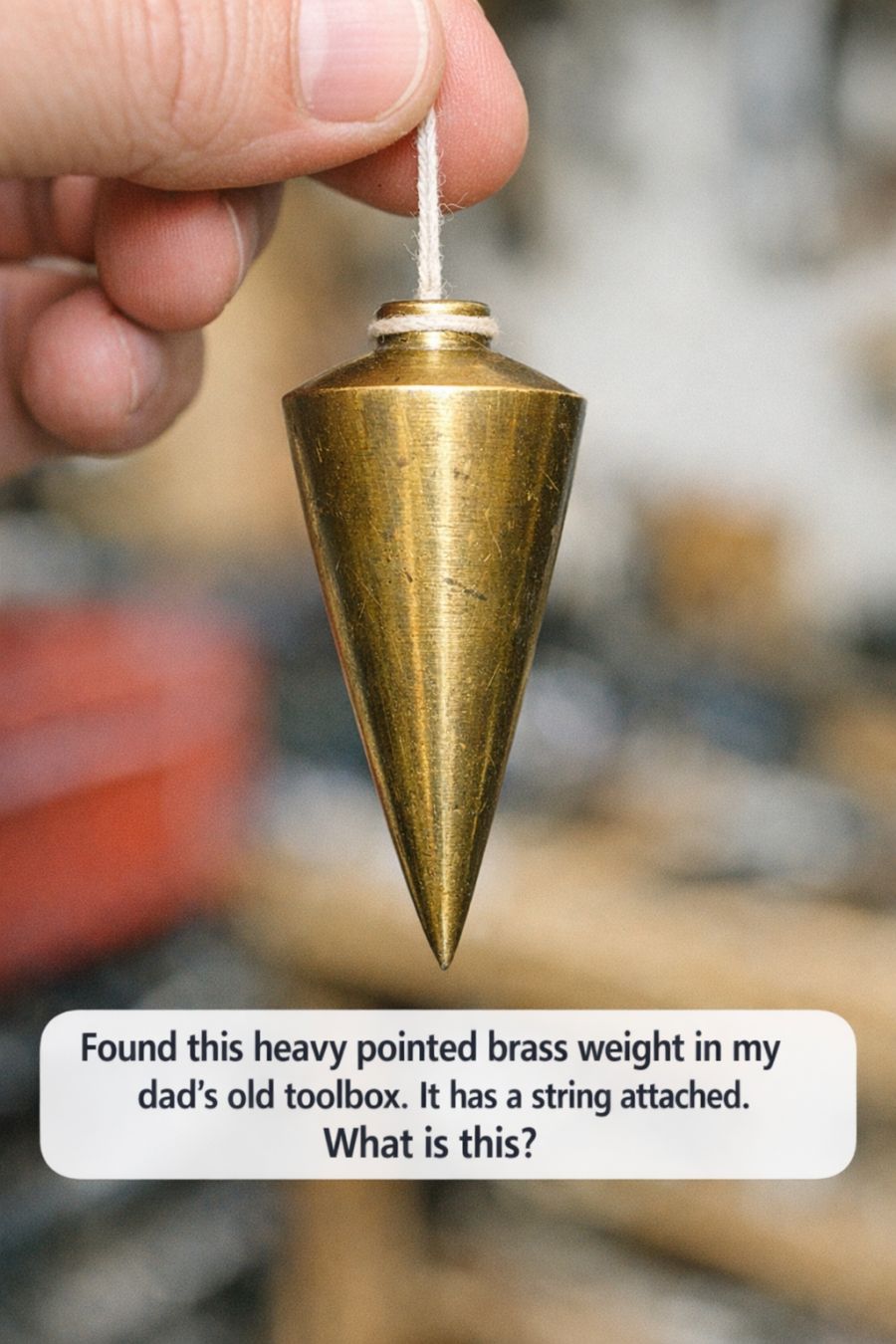
Discovering an intriguing object in a family member's old toolbox can feel like uncovering a small piece of history. The dusty, aged items often hold stories of a bygone era, revealing the practical tools that once helped in crafting, building, or repairing. Among the wrenches and screwdrivers, you might encounter a peculiar, heavy pointed brass weight with a string attached, leading to questions about its purpose and origin.
Such a find can spark curiosity not only about the object itself but also about the person who used it. Was it a part of their daily toolkit? Did it play a role in building or repairing something significant? By exploring these questions, we can gain a deeper appreciation for the tools of the past and their users' craftsmanship.
1. The Simple Answer: You’ve Found a Vintage Plumb Bob
The object you've discovered is most likely a plumb bob, a tool that dates back thousands of years. A plumb bob is a simple yet effective device used to establish a vertical reference line or 'plumb line.' Typically, a plumb bob consists of a pointed weight, often made of brass, with a string attached to its top. The pointed end ensures precision when determining vertical alignment.
Plumb bobs come in various sizes and weights, ranging from a few ounces to several pounds. The weight you found might weigh around 8 to 16 ounces, which was a common size for tradesmen. The brass construction not only provides durability but also resists corrosion, making it a preferred material for these tools.
2. What a Plumb Bob Does and Why It Has a String
A plumb bob is essentially an ancient tool used to ensure that constructions are perfectly vertical. When the string is suspended and the bob is allowed to hang freely, gravity pulls the weight directly downward, aligning the string with the true vertical. This simple principle is useful in a variety of construction tasks, from ensuring walls are perfectly upright to aligning posts and beams.
The string is crucial because it allows the plumb bob to hang freely and align accurately with gravity. The length of the string can vary depending on the application. In some cases, the string might be several feet long to accommodate tall constructions or deep measurements.
3. How Carpenters and Masons Used Plumb Bobs on Job Sites
Carpenters and masons have relied on plumb bobs for centuries to achieve precise vertical alignment in their projects. Before the advent of laser levels and modern technology, the plumb bob was an indispensable tool on construction sites. Masons used it to ensure that bricks and stones were laid in perfectly straight vertical lines, preventing any lean that could compromise structural integrity.
Carpenters employed plumb bobs to install walls, door frames, and windows, ensuring each was accurately aligned. By marking the ground or surface directly below the plumb bob's point, they could measure and adjust structures to be perfectly plumb.
4. Key Features That Identify a Classic Brass Plumb Bob
Classic brass plumb bobs are distinguished by their tapered, conical shape, often featuring a pointed tip for precision. The weight is usually attached to a string through a small hole or loop at the top. Brass provides the tool with a characteristic golden hue and often develops a patina over time, which many collectors find desirable.
Some vintage plumb bobs may have manufacturer markings or engravings, indicating the maker or year of production. These details can help identify the tool's origin and age, adding to its historical value.
continued on the next page